
Best Product Development Company for Startups: 2026 Guide

Last Updated: October 23, 2026

Quick Summary
A product development company for startups takes a founder's concept through design, engineering, and manufacturing preparation until it can be produced and sold. That work covers industrial design, mechanical engineering, prototyping, and the documentation a contract manufacturer needs to quote and build the product.
Startups hire these firms because they lack in-house industrial designers and mechanical engineers.
A single partner keeps continuity from sketch to CAD to prototype to production files.
Phased engagements let you stop, pivot, or raise before the next spend.
Confirm in writing that you own the designs, drawings, and CAD files.
Do not send a prototype to a factory and call it a production file.
Table of Contents
What a Product Development Company Actually Does for Startups
Design, Engineering, and Manufacturing Under One Roof
Top Product Development Companies for Startups Compared
2B Studio: Design-Driven Development for Physical Products
Inertia Product Development, LA NPDT, Simplexity, and Uinno
A Weighted Framework for Choosing a Startup Product Partner
Product Development Services for Startups: What to Expect
What Each Service Bucket Actually Delivers
Engagement Models and How to Sequence Them
The Physical Product Development Process, Step by Step
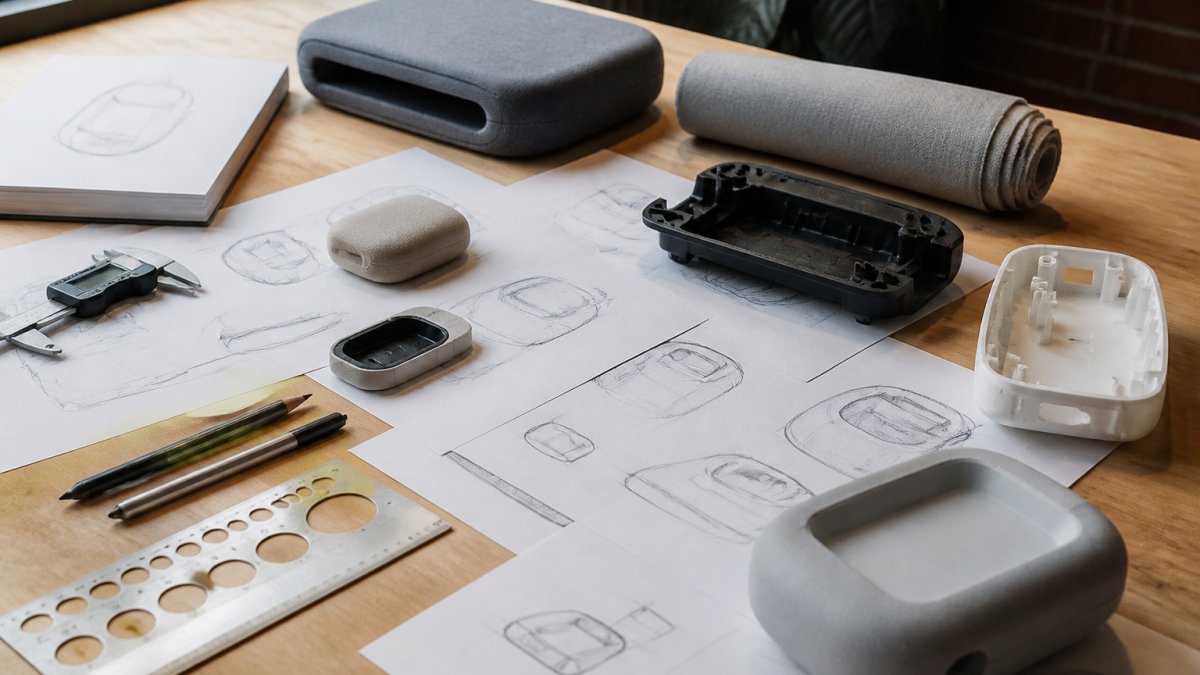
Product Design and Prototyping Services: From Sketch to Sample
Product Development Firm Selection Criteria That Actually Matter
Contracts, IP Ownership, and Scope Changes
Conclusion
Frequently Asked Questions
What a Product Development Company Actually Does for Startups
A product development company for startups takes a founder's concept and carries it through design, engineering, and manufacturing preparation until it can be produced and sold. That work covers industrial design, mechanical engineering, prototyping, and the documentation a contract manufacturer needs to quote and build the product.
At 2B Studio, we see the same pattern repeatedly: founders arrive with a strong idea and a rough sketch, then discover the gap between "concept" and "production-ready" is wider than expected. Closing that gap is the job.
A product development company is a firm that handles the design, engineering, and prototyping work required to turn an idea into a manufacturable physical product.
Startups typically hire one because they lack in-house industrial designers and mechanical engineers, and because a bad design decision made early becomes expensive to fix later. Researchers publishing in the Journal of Innovation and Entrepreneurship found that moving research-driven innovation toward commercialization depends heavily on structured development stages rather than a single leap from idea to product.
Design, Engineering, and Manufacturing Under One Roof
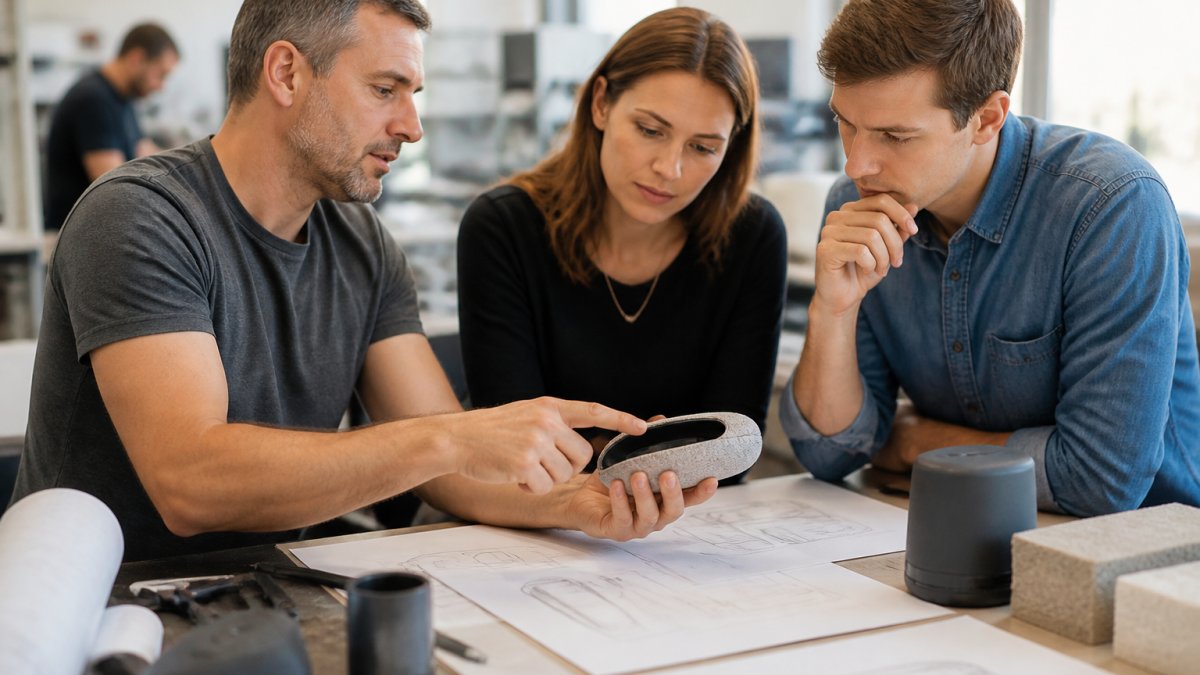
The value of a single partner is continuity. When the same team moves a product from sketch to CAD to prototype to production files, details do not get lost in handoffs. Manufacturing constraints get caught during design rather than after tooling is ordered.
That matters most for physical products, where a small change in wall thickness or material choice can change the entire cost structure.
Top Product Development Companies for Startups Compared
The best product development company for a startup depends on what the startup needs: physical product design, rapid technical validation, or engineering review before manufacturing. Below are some firms worth evaluating, starting with our own, followed by a weighted framework you can use to compare any of them on equal footing.
Company | Best For | Pricing Model | Notable Detail |
2B Studio | Physical products needing design through production | Project-based | Design-driven development, prototyping, manufacturing focus |
Inertia Product Development | Design review and prototyping | Project-based | Publishes starting price for some startup services |
LA NPDT | Inventors and small teams | Contact for pricing | Focus on moving ideas toward manufacturing |
Simplexity Product Development | Complex engineering projects | Contact for pricing | Positioned for complex product work |
Uinno | Rapid AI prototype validation | Fixed-price offering | AI-focused prototype to test a technical hypothesis |
2B Studio: Design-Driven Development for Physical Products
We build physical products. Our work spans industrial design, mechanical engineering, and prototyping, with every decision weighed against three constraints: what the factory can build, what the user needs, and what the market will pay for.
Here is how we would approach a typical startup engagement:
Discovery: understand the user, the use case, and the manufacturing budget
Concept design: explore form and function before committing to a direction
Engineering: build CAD models with manufacturing constraints baked in
Our honest limitation: we are a design and engineering partner, not a high-volume contract manufacturer. We prepare products for production and work alongside manufacturers rather than replacing them.

Inertia Product Development, LA NPDT, Simplexity, and Uinno
Uinno offers a rapid AI product prototype aimed at validating a core technical hypothesis, with a publicly listed starting price. The caveat: this offering is AI-focused and may not suit physical-product development.
A Weighted Framework for Choosing a Startup Product Partner
Most founders compare firms on portfolio aesthetics and headline price. A more reliable approach is to score each candidate against the criteria that actually predict whether your product reaches production. Weight the categories below to match your stage, then score each firm from 1 to 5 and compare totals.
Runway fit (25%): Can the firm phase the work so payments track your funding milestones? Ask whether discovery, concept, engineering, and prototyping can be contracted separately rather than as one lump program.
Stage fit (20%): Has the firm worked with pre-seed, seed, or Series A teams? A partner accustomed to corporate timelines may not tolerate the pace and ambiguity of an early-stage build.
Technical and manufacturing expertise (20%): Do they understand your specific process, injection molding, upholstery, sheet metal, or electronics integration, and can they show physical products that reached production?
Pro Tip Ask every firm what happens to the CAD files and drawings if you leave. A partner that hands over complete, editable source files at each milestone is a partner you can exit without losing your product.
A common pattern among founders who regret a partner choice is that they weighted price too heavily and ownership terms too lightly. Price is recoverable; a design you cannot legally take to another manufacturer often is not.
Product Development Services for Startups: What to Expect
Startup-focused product development services usually fall into five buckets: product strategy, industrial design, mechanical engineering, prototyping, and manufacturing preparation. What separates a good engagement from a frustrating one is not the list of buckets, it is how the work is scoped, sequenced, and priced against your runway.
Researchers publishing in the Journal of Systems and Software examined how startups balance product quality against agility, noting that the two goals pull against each other during development. That tension is why scope discipline matters more for startups than for established companies.
What Each Service Bucket Actually Delivers
Product strategy: a written problem statement, target user definition, use-case priorities, and a manufacturing budget range. Deliverable: a short strategy brief you can share with advisors or investors.
Industrial design: concept sketches, form studies, ergonomic exploration, CMF (color, material, finish) direction, and rendered concepts. Deliverable: a design direction package with 2-3 concepts to choose from.
Mechanical engineering: 3D CAD models, material and component selection, tolerance analysis, and design-for-manufacturability review. Deliverable: editable CAD and a bill of materials.
Engagement Models and How to Sequence Them
Most startups should not commit to the full program at once. A phased engagement lets you stop, pivot, or raise before the next spend. Common patterns:
Discovery-only sprint: a short, fixed-scope engagement to pressure-test the concept and manufacturing budget before committing to design. Best for founders still validating demand.
Design-and-prototype phase: concept through functional prototype, ending with a tested sample. Best for founders who need something physical to show buyers, investors, or early users.
Engineering-and-handoff phase: CAD, DFM review, and production files. Best for founders who already have a validated design and need manufacturing-ready documentation.
Ask each firm which of these models it offers and whether phases can be contracted separately. A firm that only sells the full program may be a poor fit for a pre-seed team.
Watch Out Do not send a prototype to a factory and call it a production file. Prototypes are built to prove a concept, not to define tooling. Manufacturers need engineering drawings and specifications, and a missing detail at that stage leads to rework and delay.
If you are unsure which phase you are in, that is a normal place to start. A short conversation about your concept, your budget range, and your timeline is usually enough to identify the right first step.
The Physical Product Development Process, Step by Step
The physical product development process moves through six stages: concept, design, engineering, prototyping, testing, and production handoff. Each stage produces a deliverable the next stage depends on.
Concept: define the problem, user, and constraints
Design: develop form, ergonomics, and user experience
Engineering: build CAD models and select materials
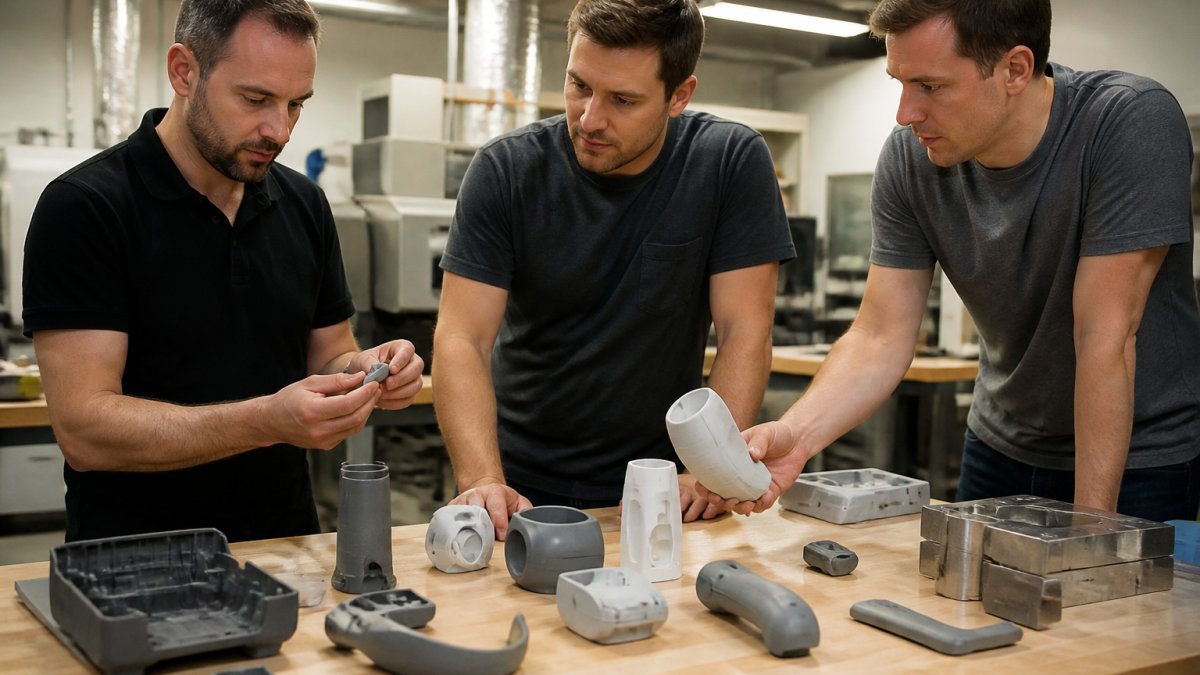
Prototyping: produce samples for physical testing
Testing: validate function, durability, and user feedback
Production handoff: finalize drawings and specifications for manufacturers
Skipping or rushing a stage is the most common mistake we see. A founder who orders tooling before testing a prototype often pays for that shortcut twice.
Product Design and Prototyping Services: From Sketch to Sample
Product design and prototyping services turn a two-dimensional concept into a physical object you can hold, test, and show to buyers.

Prototyping is not one step. A rough proof-of-concept answers "will this work at all." A refined prototype answers "will this work in the user's hands." Production-intent prototypes answer "can this be manufactured at volume."
Product Development Firm Selection Criteria That Actually Matter
The right selection criteria for a product development firm are manufacturing experience, portfolio relevance, communication cadence, and contract terms. Price matters, but it ranks below whether the firm can actually get your product built.
Use this checklist when evaluating any partner:
Can they show physical products they designed that reached production?
Do they understand your manufacturing process and material?
Who is your day-to-day contact, and how often do you hear from them?
A common mistake is choosing on portfolio aesthetics alone. A beautiful render means little if the firm has never navigated a factory quote, a tooling review, or a design-for-manufacturability pass.
Contracts, IP Ownership, and Scope Changes
Intellectual property ownership should be stated explicitly in the contract, in writing, before work begins. Confirm that you own the designs, drawings, and CAD files, and confirm when that ownership transfers.
Scope changes deserve the same scrutiny. Ask how change orders are priced and whether there is a limit. A firm confident in its process will put the answer in the contract rather than leave it to a conversation later.
Key Takeaway The three contract terms that protect a startup most are clear IP assignment, milestone-based payments tied to deliverables, and a defined process for scope changes. Get all three in writing.
Conclusion
Choosing a product development partner is one of the highest-use decisions a hardware startup makes, and the wrong fit costs months you cannot recover. If you are developing a physical product and want a partner who designs with manufacturing, user experience, and the marketplace in mind, we would like to hear about it. 2B Studio offers design-driven product development, prototyping services, and creative design partnerships that carry a concept through to a market-ready product. Say hi and tell us what you are building.
Frequently Asked Questions
How do startups choose a product development company?
Start with your stage and constraints: budget, timeline, and whether you need industrial design, engineering, or manufacturing support. Ask for examples of physical products they have taken to production, confirm who owns the IP, and request a phased scope so you are not committing to the full project upfront. A strong product development company will explain trade-offs between cost, tooling, and user experience before you sign anything, and will be candid about what they have not built before.
What does a product development company do for a startup?
A product development company handles the work between a concept and a market-ready product: user and market research, industrial design, mechanical engineering, prototyping, and manufacturing support. For startups, the practical value is access to a full team without hiring one. Research in the Journal of Systems and Software (2020) found that startups can pursue product quality while staying agile, which usually means a partner who can move between design and engineering decisions quickly rather than running a rigid, sequential process.
What should a startup prepare before contacting a product development firm?
Bring whatever you have: sketches, a problem statement, target users, rough cost targets, and any manufacturing constraints you already know about. A clear statement of what the product must do and who buys it matters more than a polished spec. Also prepare your budget range and timeline, and decide upfront whether you want a phased engagement. Firms can scope more accurately when they understand your constraints, and you will get a more honest answer about fit.
Can a product development company help prepare a product for manufacturing?
Yes, and this is where many startups lose time and money. Design for manufacturability reviews, material selection, tolerance decisions, and supplier coordination all affect whether a design can actually be produced at a viable cost. Ask specifically how the firm handles manufacturing constraints during design rather than after. A partner that balances manufacturing requirements, user experience, and marketplace demands early will reduce the chance of expensive redesigns once tooling begins.
Say hi
Add 2bstudio.com as a preferred source on Google →
Comments