
Inclusive Design for Consumer Products That Reach More Buyers

Last Updated: November 4, 2026
Quick Summary
Inclusive design for consumer products is the practice of building physical goods so the widest possible range of people can use them without adaptation, from grip strength to vision to cognition. More than 70 million US adults, better than one in four, live with a disability, and products designed with accessibility in mind can reach four times as many consumers. Treat inclusion as a process that runs through research, tooling, and post-launch feedback, not a feature bolted on at the end.
Design for permanent disabilities, temporary conditions, and situational limits so one control works for everyone.
Microsoft research cited by techUK shows inclusive principles can lift usability roughly 30% across the entire user base.
Specify measurable requirements like grip circumference and peak opening torque instead of vague goals like easy to grip.
Bundle inclusive features into the first tool cut, since adding texture or overmolding later means new tooling.
Validate inclusive features on a tooled sample, not only a machined prototype, before signing off on production.
Table of Contents
What Inclusive Design for Consumer Products Actually Means
Inclusive design for consumer products is the practice of building physical goods so the widest possible range of people can use them without adaptation, from grip strength to vision to cognition. More than 70 million adults in the United States, better than one in four, live with a disability, according to the CDC's disability and health data.
The American Marketing Association's definition of inclusive design frames it as a process rather than a finish line: products, services, and spaces intentionally created to work for as many people as possible, not just the "average" user. That distinction matters more than it sounds.
Below, we break down what inclusive design looks like at the workbench, where it pays off, and where manufacturing constraints force hard trade-offs. For the broader methodology behind it, our guide to human-centered design covers the research and empathy work that feeds it.
The Business Case: Market Reach, Brand Loyalty, and Risk Reduction
The financial argument is stronger than most product teams assume. Research compiled by the Centre for Inclusive Design via the World Economic Forum suggests products designed with accessibility in mind can reach four times as many consumers as those that are not. A 2026 national survey cited in the same body of work found 92% of consumers are more likely to support companies that actively hire and support individuals with disabilities.
That is brand loyalty earned at the design stage, not the marketing stage.
Market expansion: accessible goods open segments competitors write off
Retention: a product that works for a caregiver and the person they care for gets recommended twice
Risk reduction: fewer returns, fewer complaints, fewer redesign scrambles after launch
The catch: inclusive design is often treated as a product feature rather than a process, a critique raised in industry analysis on inclusive design practice. Teams that bolt on a bigger handle at the end miss the point. The methodology has to run through the whole lifecycle.
The article cites several figures that make the commercial case for inclusive design.
Fact | Value | Source cited |
US adults living with a disability | More than 70 million, better than one in four | CDC disability and health data |
Reach of accessibility-minded products | Four times as many consumers | Centre for Inclusive Design via World Economic Forum |
Consumers more likely to support inclusive employers | 92% | 2026 national survey |
Consumers preferring easier-to-open packaging | 42% | World Economic Forum consumer preference data |
Usability lift from inclusive principles | Roughly 30% across the entire user base | Microsoft accessibility research via techUK |
Inclusive Design Examples in Consumer Goods
The clearest examples show inclusion baked into function, not added as an accessory. Packaging leads the field: 42% of consumers prefer packaging that is easier to open, per World Economic Forum consumer preference data, which is why easy-open closures are spreading beyond medical goods into everyday retail.
Our own work follows the same logic. Valayo is a collection of seating, tables, and benches for healthcare spaces built with 1,000 lb capacity and replaceable parts, so a facility repairs rather than replaces when one component wears. Clio is a low-maintenance, height-adjustable point-of-care cart with durable casters and an intuitive interface, designed so caregivers of different heights can work without strain.
Inclusive features can overlap with durability and serviceability features, and that overlap can support the commercial case for inclusive design.
Inclusive Design Best Practices for Hardware
Good hardware inclusion starts with three user states, not one. Design for permanent disabilities (a missing limb), temporary conditions (a broken wrist), and situational limits (carrying groceries in one arm, wearing gloves in a cold warehouse). A control that works for all three works for everyone.

Practical moves we apply on hardware programs:
Size controls for the weakest grip, then check they are not too easy to trigger accidentally.
Build in tactile and visual feedback so users are not relying on one sense.
Test with assistive technology users early, not after tooling is cut.
Keep tolerances forgiving so parts still fit when a user assembles them with limited dexterity.
Microsoft's accessibility research indicates inclusive principles can lift usability by roughly 30% across the entire user base, not just users with disabilities, as reported by techUK's analysis of inclusive design. That is the number to bring to a stakeholder review.
The Design Thinking Process for Physical Products
The design thinking process for physical products moves through five stages: empathize, define, ideate, prototype, and test, with testing feeding back into the next loop. The difference from software is cost. Every prototype iteration consumes tooling time and material, so the empathize and define stages carry more weight, and the test stage has to be planned around physical build lead times rather than same-day deploys.
Here is how each stage changes when the deliverable is a physical consumer good rather than a screen.
Empathize. Inclusive research means recruiting users with motor impairments, low vision, hearing loss, and cognitive differences into the study, not surveying them afterward.
Define. Translate research into measurable requirements the engineering team can design against.
Ideate. Generate concepts against the full range of user states, not the average.
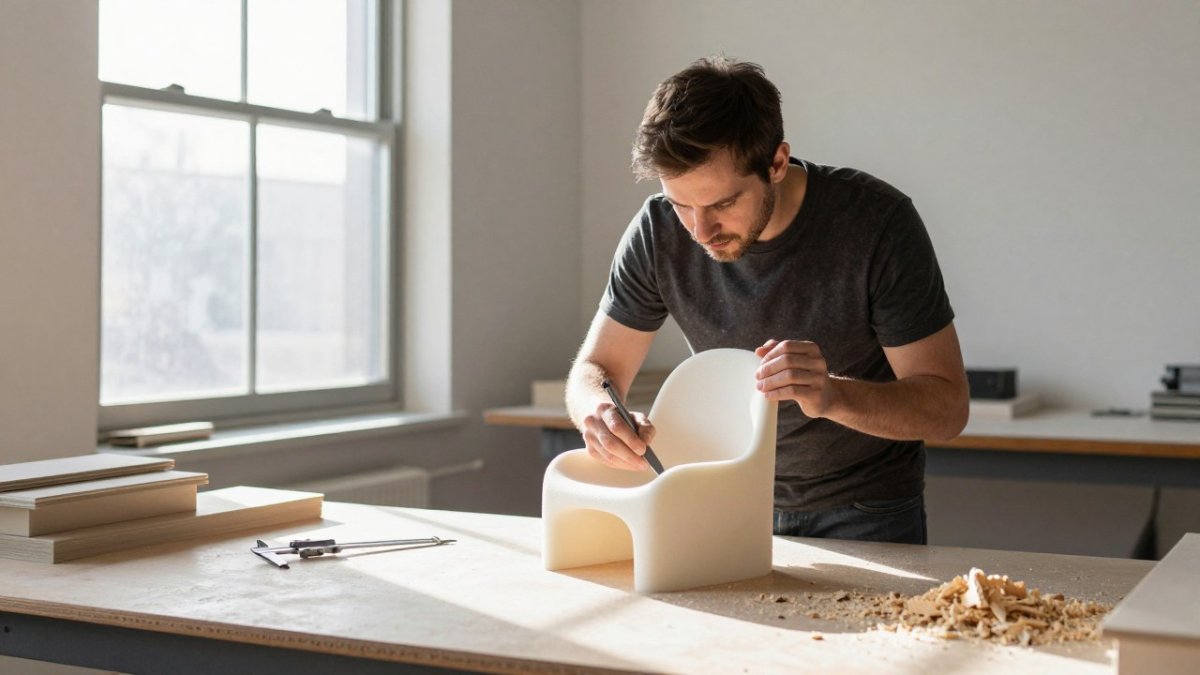
Prototype. Match fidelity to the question being asked. Foam and 3D-printed models answer ergonomic and reach questions cheaply. Functional prototypes with production-intent materials answer durability, tolerance, and assembly questions.
Test. Test with assistive technology users early, not after tooling is cut. A design bias caught at the foam stage costs a day.
For a full walkthrough of each stage, our design thinking process guide breaks down the activities and outputs.
Manufacturing Constraints: Making Inclusive Features Buildable
Inclusive features fail at the factory more often than at the sketch. A larger handle, a textured surface, or a high-contrast label all add cost and complexity to tooling, and that is where programs stall.
What we watch for on hardware programs:
Tooling changes: a new texture or overmold may require a new mold or a mold insert, so bundle inclusive features into the first tool cut. Adding a textured grip or a two-shot color band after the mold exists means either a new tool or a secondary operation, both of which add cost and lead time.
Assembly tolerance: features that help users with limited dexterity often need looser fits and larger lead-ins, which affects part design and can introduce rattle or misalignment elsewhere. Design the tolerance stack around the weakest user, then verify the tight-fit users still get a solid feel.
Material and finish choices: high-contrast colors and matte textures can cost more per unit and may limit which resins are available. Specify them early so the resin and colorant are locked before the tool is cut.
Supplier capability: not every contract manufacturer can run overmolding, two-shot molding, or in-mold labeling. Confirm the process is available at your target volume before committing to a design that depends on it.
Packaging tooling: easy-open seals, tear notches, and tactile indicators each require their own die or cutting tool. Treat packaging as a parallel tooling program, not an afterthought once the product is done.
Unit cost at volume: inclusive features that add a secondary operation often add cost per unit rather than a one-time tooling cost. Model both the tooling and the per-unit impact before the design review, because a feature that is affordable at prototype volume can be unaffordable at production volume.
The fix is sequencing. Bring manufacturing engineering into the inclusive design conversation at concept, not at production release. If a feature cannot be built at your target volume and cost, redesign it now while the mold is still a drawing.
Watch out: a feature that tests well in a prototype machined from billet can behave differently when molded, because draft angles, gate locations, and shrink affect the final geometry.
If you are weighing which inclusive features to carry into tooling, our team can review the design against your manufacturing process and volume before you commit. Reach out and tell us what you are building.
Post-Market Feedback Loops and Product Iteration
Launch is the start of the inclusive design work, not the end. Real usage surfaces edge cases no lab test predicts: the user who opens the package with their teeth, the caregiver who cleans the device with the wrong solvent, the customer who cannot read the label at arm's length.
Build a feedback loop that captures those cases deliberately:
Add a post-purchase survey that asks specifically about ease of opening, holding, and understanding instructions
Track return reasons and warranty claims for patterns tied to usability
Interview customer service reps quarterly about recurring complaints
Log every accessibility complaint as a design input, not a one-off
Iteration speed matters as much as iteration intent. Our breakdown of what drives the time required for product design revisions explains why some changes take days and others take months, which helps you plan the next revision cycle realistically.
Bringing Inclusive Design Into Your Next Product Build
The hardest part of inclusive design is not knowing what to do. It is getting a team to commit budget to features that serve users the team has never met. The answer is to make inclusion a process requirement from the first sketch, then hold it through tooling, manufacturing, and post-launch feedback.
That is the work we do at 2B Studio. Our design-driven product development balances manufacturing requirements, user experience, and marketplace demands. We offer prototyping and creative design partnerships that keep your team involved through each revision.
If you are planning a product build and want inclusion designed in rather than bolted on, say hi and tell us what you are making. We will help you turn the concept into something more people can actually use.
Frequently Asked Questions
What are some examples of inclusive design in consumer products?
Common examples include packaging with easy-open tabs and clear tactile cues, kitchen tools with larger grips, electronics with high-contrast labels and simple controls, and furniture with adjustable height or reach. Each example solves a real use case rather than adding features for their own sake.
How does inclusive design differ from universal design?
Universal design aims for one solution usable by everyone without adaptation. Inclusive design treats accessibility as a process: you research user diversity, test with edge cases, and iterate. In practice, inclusive design often produces universal-style outcomes, but the method matters. Embedding inclusive methods across the product lifecycle, rather than treating it as a final checkbox, is what critics of product-only approaches argue for. For hardware teams, that means inclusive research during concept development, not a retrofit at the end.
What are common barriers to implementing inclusive design in physical products?
The biggest barriers are manufacturing constraints, cost assumptions, and late-stage testing. Tooling decisions made early can lock out features like larger grips or tactile markers. Teams also skip inclusive research because they assume it slows timelines. A practical fix is to bring manufacturing and user research into the same design reviews so inclusive features are evaluated alongside cost and assembly. Post-market feedback loops then catch what testing missed and feed the next iteration.
How can a design partner help integrate inclusive design into prototyping?
A design partner can build inclusive criteria into the design thinking process for physical products from the first sketch. That includes defining user personas that cover permanent, temporary, and situational limitations, prototyping multiple grip and interface options, and testing with diverse users before tooling. 2B Studio works with founders and product teams to balance user experience, manufacturing requirements, and marketplace demands, Contact 2B Studio to discuss your project.
Comments